 If marketing is a pie, then content marketing is definitely the bigger slice of it. Most of the brand managers, marketers, companies and/or sectors would agree with this statement. Content marketing is indeed the most appealing trend of this year. If done right, it can create wonders to leading to traffic and driving sales. The key to this is to have a plan, a plan to target effectively & grab your target audience’s attention. There is no doubt about the fact that social media & mobile marketing have also showcased content to be supreme. Brands therefore, are now creating original content to engage customers. If B2B sector is taken into consideration, here the brands foster content usage by positioning company as a thought leader to the customers, producing demand.
Consumers also want a lot of information now and at the same time they want to make their own decisions. In that case brands need to provide valuable content to build trust.
Following all the changes and strategic developments happening all year around, this year marks some of the fantastic content marketing trends, when implemented correctly are sure to drive the business and brands to a great level.
Last minute web plugs, ad hoc promo driven microsites and integrating a social media strategy as an addition won’t work anymore! For a healthy and successful way forward, strategically planned content and distribution supported by well done research & inputs is the key.
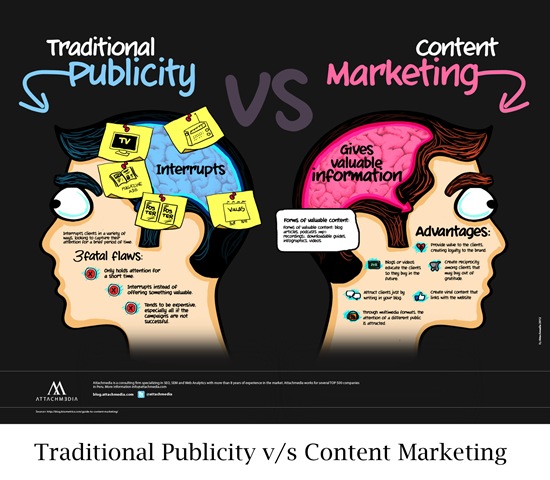
Traditional publicity and content marketing differences are many. Just have a glimpse:
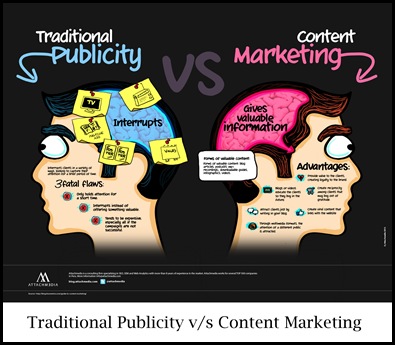
Source: http://blog.kissmetrics.com/guide-to-content-marketing/
Moving on lets talk about the Social media & content marketing trends
Case studies, evolving as the most important part of content marketing are very essential when it comes to products & services. From “how it works” to “this is what I need”, case studies provide all the information related to a particular products.
E-books fill the space of B2C content marketing wherein all the questions on how to get the most out of a service or product will be a part of the content. A content that creates a comfort zone for buyers is another essential part.
Storytelling is become the most liked trend today. With everyday happenings on the social media platforms and content overflowing from all ends, some of the amazing stories are sure to get an edge. Here businesses can add that personal touch & experience with real examples and share it with people, the content they actually want to read.
Blogging by businesses will take the lead in times to came, infact it is already considered as the foundation of all sorts of content marketing actions. Blog encapsulates all types of content, posts, e-books etc. followed by links to the content in the blog.
Creating enough and original content might turn out to be the biggest challenge for content marketing. Marketers would be pressurized to come up with content based on superior quality & originality.
Social media will stand out as the most popular channel with Facebook, Twitter, Linkedin etc. distributing content that is liked and shared by people. The content can also be stored in the blog and shared with the social media platforms when required.
Content marketing goals would be sales & retention wherein B2B content would spawn leads & sales and B2C brands would move ahead with a goal of retention & generating word of mouth.
Content would be used all over. A single piece of content would be distributed & stretched to almost all the platforms where marketers will try to maximize their value. Revamping the existing content will also lighten the creation of content.
Mobile optimized content is creating buzz. Creating a mobile friendly content with a click to call option is sure to give you an edge over your competitors. From blogs, websites, case studies, e-books, videos and all other content should be made mobile friendly.
Content curation might be used as an alternative as marketers who fall short on time to create their own piece of engaging & original content shift to curation. Curation would include churning out the best content and sharing it across the social media platforms. It will lead to the brand losing its value & visitors to the page, at the same time being known as staying updated. A proper balance of original and curated content would be a good strategy.
Video would be the greatest trend with amazing video content. If you are planning to go viral with your content, then video is the answer. Short videos with easy steps to follow are good enough for engaging people who further share the content. Compelling content is the need of the hour for longer videos to make people sit back and watch. It should be shareable and eye catching. That’s it!
Infographics are a rapidly growing content format which have the visual appeal & information that is easy to understand and share.
Targeted content will get more results. Understanding the interests of potential customers and creating content based on that would foster engagement. Exploring on the buying behaviour of people will help generate targeted content.
E-mail, the most used and effective marketing channel can be leveraged by understanding the marketing goals and designing the communication to influence the buyers or consumers.
Budgets. There won’t be any slash down when it comes to content marketing. There would be increased spending on the same.
Gamified content strategy is on the rise. As the customers are getting influenced by online activities etc., they are expecting gratification to interact & engage with brands online, content that renders entertainment, learning & rewards is appreciated in a big way.
Expanding Social Media and its users generate a challenge for marketers when it comes to designing the content marketing strategies. Social media will continue to stand out as the greatest resource of real-time content distribution which is rising amongst the audiences.
Understanding the content & digital link is important. Content strategies need to be designed keeping in mind the digital strategies. Anybody could get the likes on Facebook, but what makes brands stand out is what they do with those likes. Its about the target audience and engaging them with content that brings them back everytime to the brand page. Facebook likes are not the content. Content is now also linked to SEO.
A breakthrough content backed by a strategically thought idea that the businesses or brands can deliver across platforms is the strongest step towards success.
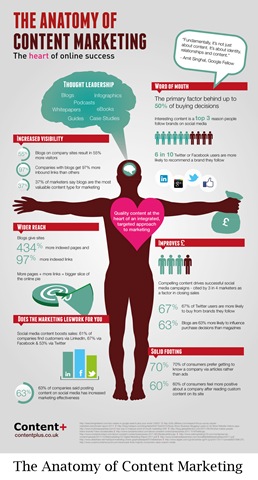
Have a look at this, the anatomy of Content Marketing.
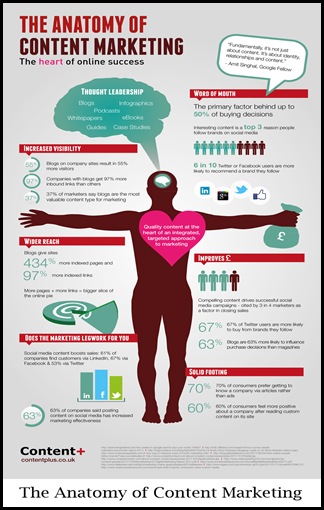
Image courtesy: contentplus.co.uk
Brand managers and marketers are on a constant run to look out for ways to build consumer engagement, acquire and retain them. In order to win the race of attracting the target audience marketers will have firstly capture their minds with the product, offers etc. and secondly create connecting content.
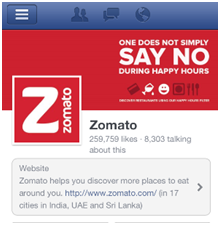
Lets see what Zomato.com, that offers restaurants listings of restaurants, food reviews etc. did. It also has Android & iOS apps that are easy enough to use. It is also active on Facebook & Twitter garnering amazing likes and fan following.
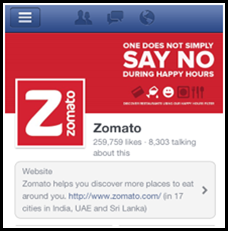
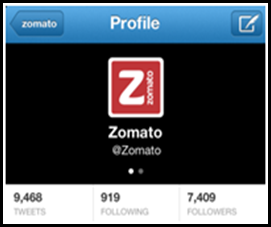
Zomato engages with its customers regularly on these social media platforms. They constantly urge their customers to praise the food etc. and also stay clear of being praised and promoting itself everytime. Recently, they came up with Food Porn Site to get more visible, where people could look at pictures of scrumptious & luscious food. Zomato also regularly maintains its presence on blogs & sites to escalate their reach and visibility.
COKE
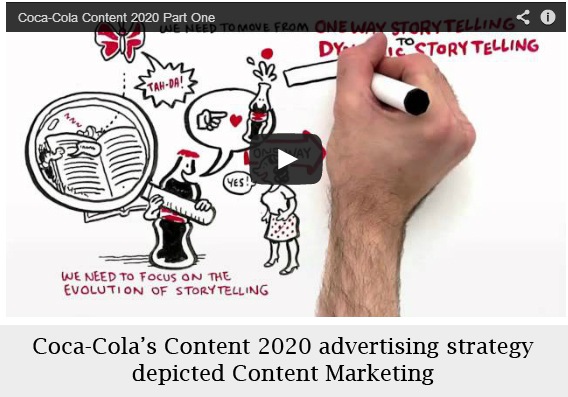
Coca-Cola strongly believes in content marketing and therefore it is their core strategy of Content 2020 advertising strategy mission: "All advertisers need a lot more content so that they can keep the engagement with consumers fresh and relevant, because of the 24/7 connectivity. If you’re going to be successful around the world, you have to have fat and fertile ideas at the core."
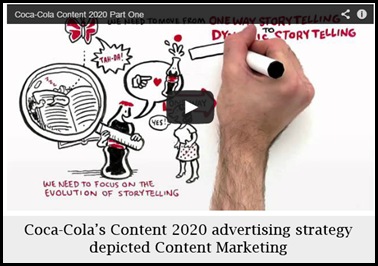
Click here to watch.
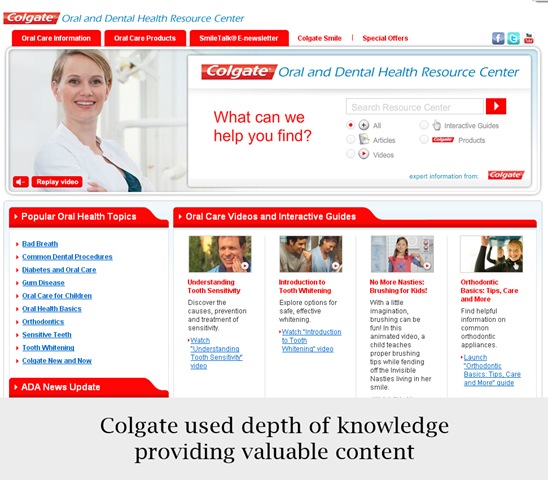
COLGATE
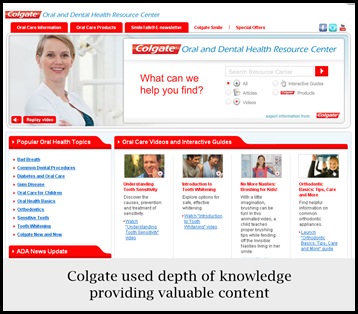
Colgate provides an online Oral and Dental Health Resource center with videos, interactive guides, and over 400 articles. It’s a great example of a brand seeing itself as a publisher and using its depth of knowledge to provide valuable information to people, which is the key to content marketing success. Even a two person company can pull from their experience and expertise to create blogs, e-newsletters and e-books in an organized and effective way that reaches prospects.
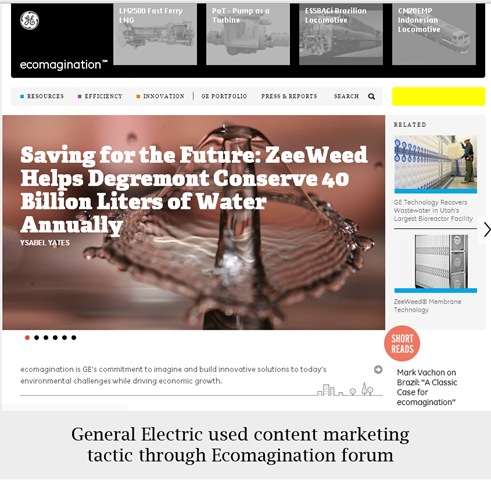
GENERAL ELECTRIC
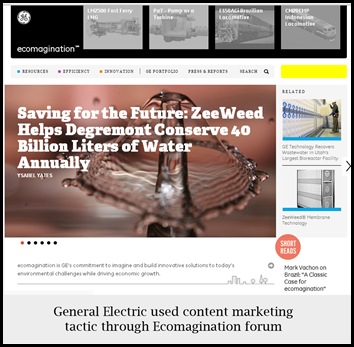
General Electric used content marketing to tell the story of the 132-year-old brand through different content channels. They used the content tactic Ecomagination, which is a forum for fresh thinking and conversation about clean technology and sustainable infrastructure. According to Katrina Craigwell, Digital Marketing Manager at GE’s belief, “At the end of the day, if the content isn’t good enough for the end user to want to share it with a friend or colleague, we haven’t quite succeeded.”
So, it is evident how brands are constantly updating & innovating their content, offerings and approach to connect with their customers. Also the way social media platforms are used, it beautifies the brands’ marketing. Content is surely the king as it is encouragingly served & shared to a large audience in multiple ways.
Recently, there was a brand owner’s summit where it was showcased how "Brand marketing has given way to content marketing". Check this link to read through!
A proper plan, relationship building, long term thinking and consistency helps a brand go long way with its content marketing.
What clicks through is the relationship that a brand builds with its influencers and consumers etc. They help drive in traffic by posting and sharing the content from website to various other networks.
Content is the heart of social media. It is the life savior of branding campaigns. Don’t you agree? Yes, it is. It is a lot more than an SEO, a tweet, blog or Facebook post etc. Need to create an original content is very essential. A content that moves away from brand messages to the one that’s relevant & approachable for consumers.
For a content that is not only significant but exceptional, one should aim to create, curate, plan & collect the same.
In 2012, there was a great rise in the use of images in content marketing with social media platforms like Pinterest & Instagram followed by Facebook, Linkedin & Twitter which focused on imagery. With the beginning of 2013, content marketing has evolved yet in another great way.
Brands and organizations need to plan a framework for their content marketing. They have already started looking out for media platforms to purchase & bloggers to manage the same. In almost every industry there is a great prospect for a appropriately planned content strategy.
Times ahead are now going mobile.
Mobile web browsing is also expected to outdo the web browsing through desktops and laptops. Content marketers will therefore have to create content suited to the mobile lifestyle.
The website should be designed in a way that is compatible with the smartphone. And with smartphone users and consumers increasing every fraction of a second they always expect the content to be readable on their mobile devices which they carry almost everywhere they go.
These trends are a witness to a movement that was prevalent for years and now trying to reach a larger mass. Brand managers and marketers have also come to a conclusion that social media channels are not that effective without an appealing content to engage. How would you analyse the role of content in the World where the complete consumer behaviour has changed? Don’t you think content is the most eminent marketing strategy? Do you think 2013 will be the year of content marketing with innovations & intelligence? It is expected that the applications would be developed to improve the efficiency of content creation. Would it help publishers to polish the performance of their content on web or social media? How would it improve the ROI?

 If you are still under impression that only your resume and technical & communication skills are considered while recruitments, you need to revise your assumptions, especially if you are a job seeker and active on various social media platforms. Your social media activities have a major impact on your recruitment possibilities.
  If a company has strict policies against internet and smartphone usage, it may want to avoid a social media addict who updates his whereabouts and activities every hour. Similarly, posts about hating Mondays and weekdays can put a negative impression about your professionalism and passion for work. The smart way to get through the social media scrutiny could be narrowing the industry you want to join, studying the basic criteria of judging a candidate’s personal branding by the firms and designing your personal branding strategy accordingly.
 There are certain don’ts and no-no’s too that you should always take care of while posting stuff on social media. Writing a post about how you felt after a hangover, a rendezvous with local police, caste-race based comments, supporting use of abusive language, etc. are the things that might land you in trouble. What can help you authenticate your profile can be your posts and pictures of doing the tasks for the social causes that you have signed up for in your profile introduction.
![clip_image002[6]](https://windchimes.co.in/blog/wp-content/uploads/2015/08/clip_image00262.jpg "clip_image002[6]")